
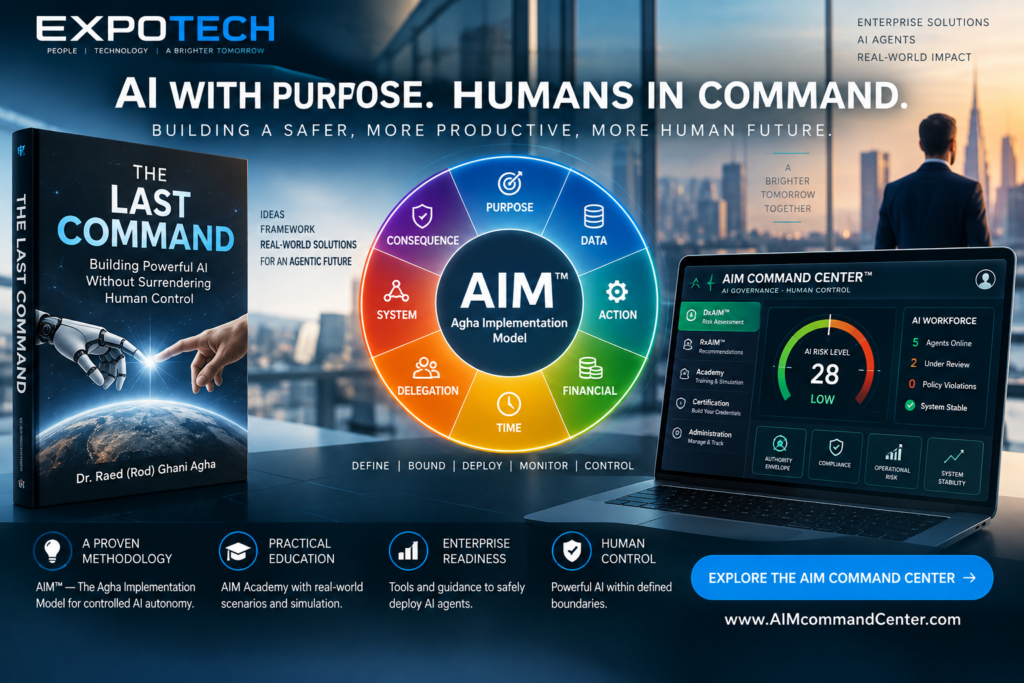
Building Powerful AI Without Surrendering Human Control
Artificial intelligence is rapidly moving beyond answering questions and generating content. AI agents can now analyze, decide, communicate, access enterprise systems, delegate work, initiate transactions, and take action.
That creates a new challenge for every organization:
How do you give AI enough authority to create value—without surrendering human control?
Expotech addresses this challenge through AIM™ — the Agha Implementation Model, a structured approach for designing, deploying, governing, and scaling AI agents while maintaining clearly defined human authority.
AIM™ provides organizations with a practical framework for answering not only what an AI agent can do, but the more important question:
What should the AI be allowed to do?
From AI Capability to Controlled AI Autonomy
Traditional software executes predefined instructions. AI agents can operate with increasing levels of independence.
An agent may be capable of accessing databases, communicating with customers, generating purchase orders, modifying business records, interacting with other agents, or initiating actions across multiple enterprise systems.
The more capable the agent becomes, the more important its authority boundaries become.
Expotech uses AIM™ to help organizations establish those boundaries before autonomy is expanded.
The objective is not to prevent AI from acting.
The objective is to make certain that AI acts within the authority humans intended to give it.
At the center of AIM™ is the concept of an Authority Envelope—the explicit boundaries within which an AI agent is permitted to operate.
AIM™ evaluates authority across eight dimensions:
Purpose • Data • Action • Financial • Time • Delegation • System • Consequence
Together, these boundaries establish what an agent may access, what it may decide, what actions it may take, how far those actions may reach, and when human authorization must be required.
The principle is simple:
AI should never possess more effective authority than humans intentionally approved.
This approach allows organizations to pursue powerful AI capabilities while preserving accountability, oversight, revocation, and human command.
AIM™: A Lifecycle for Controlled AI
AIM™ is designed to support AI throughout its lifecycle—from concept and development through deployment, operation, monitoring, and eventual retirement.
Organizations can use the methodology to:
- Discover where AI agents are already operating or being proposed.
- Classify agents according to capability, autonomy, access, and potential consequences.
- Design appropriate authority boundaries and human controls.
- Authorize specific actions, systems, data, financial limits, and delegation rights.
- Monitor agent behavior and detect movement outside approved boundaries.
- Intervene when predetermined red lines or tripwires are reached.
- Revoke authority and return systems to a safe state when necessary.
The result is an AI operating model in which capability can increase without human authority disappearing.
The AIM Command Center™
Principles become valuable when organizations can put them into practice.
The AIM Command Center™ is the operational environment supporting the AIM methodology. It provides tools for assessing AI autonomy, defining authority boundaries, identifying risk, training personnel, and developing organizational competency in controlled AI deployment.
DxAIM™ — Diagnose
Evaluate AI agents across key autonomy and risk dimensions to understand where authority, exposure, and organizational controls may require attention.
RxAIM™ — Respond
Translate assessment findings into practical recommendations for boundaries, controls, oversight, and remediation.
AIM Academy
Learn how to design, manage, and govern AI agents through practical instruction, scenarios, simulations, and enterprise use cases.
Certification
Develop measurable competency in AIM principles and the responsible implementation and management of autonomous AI systems.
Explore the AIM Command Center:
AIMCommandCenter.com
AIM Academy
Learn to Command AI—not Simply Use It
The next generation of professionals will need skills that extend beyond prompting AI.
Executives, managers, developers, architects, cybersecurity professionals, and business leaders increasingly need to understand how to assign authority to AI, establish limits, supervise autonomous behavior, recognize dangerous escalation, and retain the ability to intervene.
AIM Academy was created around that challenge.
The Academy combines instruction with scenario-based learning and simulation so participants can experience the decisions involved in deploying increasingly autonomous AI systems.
Rather than simply learning concepts, participants are placed in realistic situations where they must determine:
What authority should this agent receive?
What information should it access?
Can it spend money or execute transactions?
Can it delegate authority to another agent?
When should human approval be mandatory?
What happens when an agent approaches or crosses a boundary?
How can its authority be revoked?
This turns AI governance from an abstract policy discussion into a practical management discipline.
The Book Behind the Methodology
The Last Command
Building Powerful AI Without Surrendering Human Control
By Dr. Raed (Rod) Ghani Agha
As artificial intelligence becomes increasingly capable of independent action, organizations face a fundamental question:
When machines can act, who remains in command?
The Last Command examines the transition from AI as a tool to AI as an autonomous actor within organizations.
The book introduces AIM™ and explores the architecture, governance principles, authority boundaries, risk models, organizational controls, and leadership practices required to deploy powerful AI without unintentionally transferring control from people to machines.
It is written for executives, technology leaders, AI developers, cybersecurity professionals, business leaders, educators, and students preparing for an increasingly agentic enterprise.
The book and AIM Command Center work together:
The Last Command explains the methodology.
AIM Command Center puts the methodology into practice.
AIM Academy teaches people how to apply it.
From the Book to the Command Center
AIM™ is designed to bridge four critical areas of enterprise AI:
Theory → Assessment → Implementation → Competency
The Last Command establishes the concepts and methodology.
DxAIM™ helps organizations assess AI autonomy and exposure.
RxAIM™ helps translate findings into controls and corrective actions.
AIM Academy and Certification help organizations build the human skills necessary to manage autonomous systems.
Together, they create an integrated approach to AI development, governance, education, and human control.
Build AI That Knows Its Boundaries
AI agents will continue to become more capable.
The long-term challenge will not simply be building more intelligent systems. It will be determining how much authority those systems should receive—and ensuring that humans retain the ability to change, restrict, or revoke that authority.
Expotech combines decades of enterprise technology experience with AI agent development and the AIM™ methodology to help organizations move toward autonomous AI with clearly defined human control.
Intelligence can be delegated.
Authority must be designed.
Discover AIM™. Experience AIM Academy. Put your AI agents to the test.
ENTER THE AIM COMMAND CENTER →


